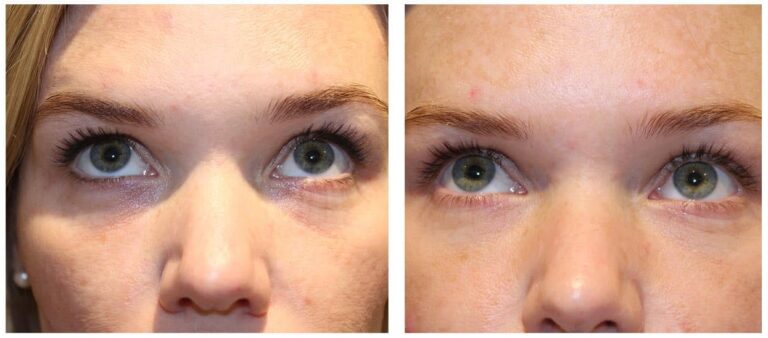
Under-eye rejuvenation is one of the most requested aesthetic treatments. The under-eye area is often the first place where aging becomes visible. The skin here is thin and delicate, which makes it more prone to volume loss, fine lines, shadowing, and dark circles. Even patients who look youthful and energized may notice that their eyes are tired or hollow. Because the eyes are central to facial expression, subtle changes in this area can significantly affect overall appearance.
Many patients ask whether platelet-rich fibrin (PRF) or dermal fillers are the best for under-eye rejuvenation. The answer is not about choosing one over the other. Each treatment addresses different causes of under-eye aging. Understanding those differences is key to selecting the right approach.
Why the Under-Eye Area Ages Differently
The skin beneath the eyes contains less collagen and fewer oil glands compared to other areas of the face. As natural collagen production slows with age, the skin becomes thinner and more translucent. This can make underlying blood vessels more visible, contributing to dark circles.
At the same time, gradual loss of fat and structural support in the midface creates hollowing, often referred to as tear trough deformity. When light hits this hollow area, it casts shadows that deepen the appearance of tiredness.
PRF: Regenerating Skin from Within
Platelet-rich fibrin (PRF) is derived from your own blood and contains concentrated growth factors that support tissue repair and collagen stimulation. Unlike fillers, PRF does not add volume. Instead, it improves the quality and thickness of the skin gradually.
PRF is particularly beneficial for patients experiencing thinning skin, crepiness, or subtle discoloration. Because it stimulates natural collagen production, results develop progressively over several weeks.
This regenerative approach is ideal for patients who want to enhance tissue health rather than immediately change facial contours.
Dermal Fillers: Restoring Structural Support
Hyaluronic acid fillers are designed to restore lost volume in areas where fat depletion has created hollowing. In the tear trough region, fillers reduce shadowing by correcting the contour beneath the eye.
Results are visible immediately. By restoring structure, fillers can create a smoother transition between the lower eyelid and cheek.
However, fillers do not improve skin thickness or pigmentation. Their role is structural, not regenerative.
PRF vs. Fillers: Key Difference Explained
Although PRF and dermal fillers are both used for under-eye rejuvenation, they function in fundamentally different ways and target different aspects of aging.
PRF is a regenerative treatment. By delivering concentrated growth factors derived from your own blood, it stimulates collagen production and supports tissue repair. Over time, this can improve skin thickness, texture, and overall quality. Because PRF works gradually, results develop progressively and tend to look subtle and natural. It enhances the biological health of the tissue rather than altering facial contours.
Dermal fillers, on the other hand, are structural. Hyaluronic acid-based fillers restore lost volume beneath the tear trough, immediately reducing hollowing and shadowing. The improvement is visible immediately after the treatment. However, fillers do not significantly change skin thickness or pigmentation. Their role is to reestablish support where volume has diminished.
Another important distinction is longevity and progression. PRF often requires a series of treatments and maintenance to build collagen gradually. Fillers provide immediate correction, with results typically lasting many months, depending on the product and individual metabolism.
Because these treatments address different layers of aging — PRF improving skin quality and fillers correcting structural volume — they are not interchangeable. In many cases, they complement one another. A patient with both thin skin and hollowing may benefit from strengthening the tissue first, followed by careful volume restoration. The order and combination depend entirely on anatomy and aesthetic goals.
A Personalized Approach to Under-Eye Rejuvenation at Glamor Medical
Choosing the right treatment for the under-eye area requires more than selecting between PRF and fillers. It begins with a careful evaluation of facial anatomy, skin thickness, degree of volume loss, and overall facial balance. Because this region is delicate and structurally complex, subtle differences in technique and product selection can significantly influence the outcome.
At Glamor Medical, under-eye rejuvenation is guided by precision and anatomical understanding. Some patients benefit from regenerative support to strengthen thin tissue. Others require structural correction to restore contour. In certain cases, a staged combination approach offers the most harmonious result. The goal is always a balanced, natural-looking improvement that respects the integrity of the under-eye area.