

Best Treatments for Skin After Weight Loss
You reach your goal weight, and you expect to feel done. Then you look in the mirror and notice that something does not match. Your jawline looks softer than you
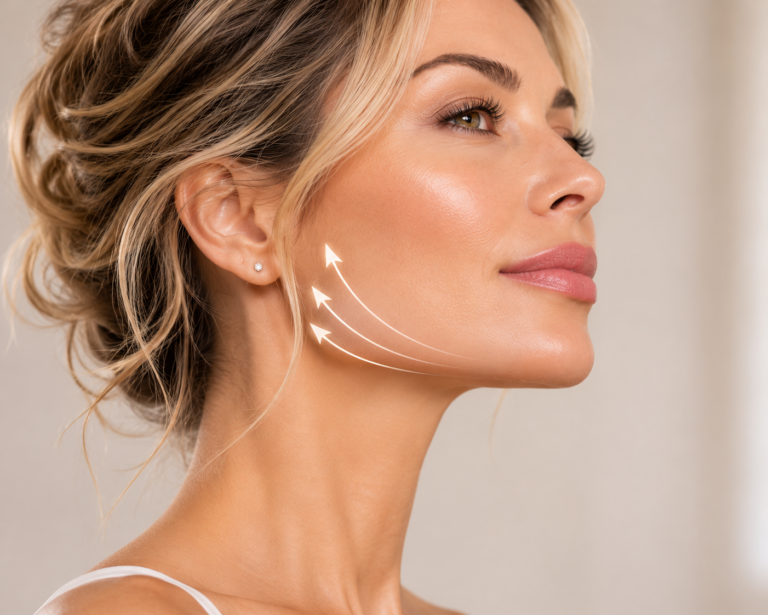
XERF, Ultherapy, Endolift, and injectables can all improve the appearance of jowls, but which one is right for you?
One of the most common concerns we hear at Glamor Medical is, “My jawline used to be so much more defined. What happened?”
Sometimes patients notice it in photographs. Others see a little heaviness around the corners of their mouth or feel that their lower face looks wider and less lifted than it used to. And almost everyone asks the same question: Can I get rid of my jowls without a facelift?
The answer depends on what is causing them.
At Glamor Medical in Boca Raton, we use several approaches to improve the appearance of jowls, including XERF, Ultherapy, Endolift, Sculptra, Radiesse, and carefully placed dermal fillers. But we don’t believe there is one treatment that works best for every face.
Some jowls develop primarily because the skin has lost firmness. Others involve changes in facial fat, loss of structural support, or a combination of all three. Understanding those differences is the first step toward choosing a treatment that actually makes sense.
Jowls are the areas of sagging or fullness that develop along the lower jawline, typically on either side of the chin.
As we age, several changes happen at once. Collagen and elastin decline, the skin gradually becomes less resilient, facial fat compartments change position and volume, and the underlying structures that support the face also change.
One particularly important change is the loss of support in the cheeks and midface. When the upper and middle face lose volume, the lower face may begin to look heavier by comparison.
The ligaments and connective tissues that help maintain facial contours also change over time. Gravity contributes, but it isn’t the whole story.
This explains why two patients can have similar-looking jowls but need completely different treatments.
A patient with relatively good facial volume and mild skin laxity may benefit from collagen stimulation. Someone with hollow cheeks and a heavy-looking jawline may need volume restoration instead. And a patient with localized fat and loose skin may require an approach that addresses both.
Weight loss can make these changes more noticeable, especially when facial fat decreases faster than the skin can adapt.
| Treatment | Best suited for | How it works | Results |
|---|---|---|---|
| XERF | Mild to moderate lower-face laxity | Multifrequency radiofrequency stimulates collagen at different tissue depths | Gradual improvement in firmness and definition |
| Ultherapy | Mild to moderate skin laxity of the lower face and neck | Microfocused ultrasound targets specific tissue depths | Gradual lifting and tightening in selected patients |
| Endolift | Selected cases involving laxity and localized fat | Minimally invasive laser energy delivered beneath the skin | Progressive tightening and contour refinement |
| Sculptra | Loss of facial collagen, volume, and support | Stimulates gradual collagen production | Progressive restoration of facial fullness and support |
| Radiesse | Loss of structural support and contour definition | Calcium hydroxylapatite provides support and stimulates collagen | Immediate contour improvement with additional collagen response |
| Hyaluronic acid fillers | Specific areas of volume loss or jawline irregularity | Restores volume and provides targeted structural support | Immediate, with final appearance after settling |
The important distinction is that these treatments don’t all lift jowls in the same way. Some work on skin firmness, some restore facial support, and others help refine the contours around the jawline.
And in certain patients, combining treatments is more effective than relying on one procedure alone.
If a patient has mild to moderate jowling and the lower face is beginning to lose definition, XERF may be one of the treatments we consider.
XERF is an advanced radiofrequency skin-tightening technology that delivers energy at multiple tissue depths to stimulate collagen remodeling.
We particularly like its ability to address the lower face and neck without needles or surgical incisions.
At Glamor Medical, we often recommend a series of two XERF treatments approximately 30 days apart, depending on the patient’s needs.
Results develop gradually as collagen remodeling takes place. Patients may notice improved firmness and a more defined appearance along the jawline over time.
However, XERF cannot reposition significantly descended facial tissues or replace the lifting achieved through surgery. It is most appropriate when the degree of laxity is within the range that energy-based tightening can reasonably improve.
Ultherapy is another treatment we use when facial laxity is contributing to jowls.
While XERF uses radiofrequency, Ultherapy uses microfocused ultrasound to stimulate collagen at specific depths beneath the skin. Its real-time ultrasound imaging allows us to visualize the tissue during treatment.
Ultherapy can be particularly useful when we want to target deeper structural layers involved in facial support.
Does that make Ultherapy better than XERF for jowls?
Not necessarily.
Both treatments stimulate collagen, but they deliver energy differently. We consider the patient’s anatomy, skin thickness, treatment history, degree of laxity, and personal preferences when deciding which approach may be more appropriate.
For some patients, XERF is a better fit. For others, Ultherapy may offer advantages.
Our decision isn’t based on which device is newer or more popular. It is based on what we are trying to improve.
Sometimes what appears to be sagging skin is partly caused by localized fat around the lower face or beneath the chin.
In these cases, skin tightening alone may not produce the contour improvement the patient wants.
Endolift offers a different approach.
At Glamor Medical, we perform this minimally invasive procedure using the LEVAGE FUSION laser system. Ultra-thin fibers deliver laser energy beneath the skin to stimulate collagen remodeling and, in appropriately selected areas, address localized fat.
This can make Endolift an option when a patient has both skin laxity and excess fullness contributing to a less defined jawline.
But we are especially careful when evaluating facial fat.
Not every heavy-looking lower face needs fat reduction. In some patients, the apparent heaviness is actually related to volume loss higher in the face and tissue descent. Removing more fat in the wrong area can make the face look older or less supported.
Endolift also involves more downtime and procedural considerations than external skin-tightening treatments, so patient selection is important.
This is one of the most important things we explain during consultations.
A patient may come in asking us to tighten their jowls, but when we examine their face, we find that the cheeks have lost volume and the surrounding structures no longer provide the same support.
In this situation, focusing exclusively on the jawline may not be the best approach.
Sculptra is a collagen-stimulating injectable that helps restore facial volume and support over time.
We consider it when the face has experienced a broader decline in collagen and fullness, particularly in the cheeks and other areas where restoring volume may improve overall facial balance.
Sculptra does not physically lift descended tissue in the way surgery can. Instead, it can improve the appearance of the face by gradually restoring support in appropriately selected areas.
This is especially relevant for patients who have experienced facial volume loss with aging or significant weight loss.
Radiesse is a calcium hydroxylapatite-based injectable that provides immediate structural support and encourages collagen production.
Depending on the patient’s anatomy and the technique used, it may help improve contour and definition in selected areas of the lower face.
We may choose Radiesse when the treatment plan calls for more targeted structural support rather than gradual volume restoration alone.
Sculptra and Radiesse are not interchangeable, and neither is automatically the better choice for jowls. The decision depends on where support has been lost and how much volume the face actually needs.
Yes, but this is an area where technique and restraint matter enormously.
Dermal fillers can help improve the appearance of jowls by restoring volume in carefully selected areas, such as the cheeks, chin, or regions along the jawline.
For example, a small amount of filler placed strategically near a jawline indentation may create a smoother contour.
However, adding filler directly around an already heavy lower face can sometimes make the problem more noticeable.
We don’t want to create a larger or wider jawline just to disguise a small amount of sagging.
The goal is to restore facial proportions, not simply fill every area that looks hollow.
For patients with significant tissue descent, filler alone may not be sufficient, regardless of how much product is used.
At Glamor Medical, we start by looking at the entire face rather than treating the jowls as an isolated problem.
When a patient tells us their jawline is disappearing, we examine the cheeks, chin, lower face, neck, skin quality, and overall facial proportions.
We want to understand whether the main concern comes from skin laxity, reduced collagen, lost facial volume, localized fat, or structural changes.
Here are a few examples of how that assessment can influence our approach:
If the skin is loose but facial volume is well preserved: We may focus on collagen-stimulating treatments such as XERF or Ultherapy.
If the cheeks have become hollow and the lower face appears heavier: Restoring support with Sculptra, Radiesse, or selected fillers may be more appropriate.
If there is localized fullness beneath the chin along with skin laxity: Endolift may be considered after evaluating the fat distribution and tissue quality.
If the patient has several contributing factors: A combination approach may offer a more balanced improvement than one treatment alone.
These aren’t fixed treatment formulas. They illustrate why two people asking for the same result may receive very different recommendations.
Absolutely, when the combination addresses different aspects of facial aging.
One patient may benefit from collagen stimulation to improve lower-face firmness and an injectable to restore volume higher in the cheeks. Another may need more targeted contour refinement followed by a separate treatment to improve skin quality.
We don’t necessarily perform everything at once. The order and timing depend on the patient’s anatomy, treatment goals, and how the tissues respond.
Our philosophy is simple: we would rather combine a few carefully selected treatments than overcorrect one area and compromise the balance of the entire face.
There is no single most effective treatment for everyone. XERF and Ultherapy may improve mild to moderate skin laxity, Endolift may help selected patients with laxity and localized fat, and injectables may improve facial support and contour. The best choice depends on the cause and severity of the jowls.
Non-surgical treatments can improve the appearance of jowls, particularly when sagging is mild to moderate. However, they cannot reproduce the degree of tissue repositioning achieved with a surgical facelift.
Both can stimulate collagen and improve skin firmness, but they use different technologies. Ultherapy delivers microfocused ultrasound with imaging guidance, while XERF uses multifrequency radiofrequency. The better option depends on individual anatomy and treatment goals.
Sculptra may improve the appearance of jowls when facial volume and collagen loss contribute to reduced support. It does not directly reposition sagging tissue, so it may be combined with other treatments when skin laxity is also present.
It can, if too much filler is used or it is placed in areas that add unnecessary weight or width to the lower face. In appropriately selected patients, carefully placed filler can improve jawline definition.
When jowls are pronounced and there is substantial tissue descent or excess skin, surgery generally offers more significant and predictable lifting. A responsible consultation should include an honest discussion of what non-surgical treatments can and cannot achieve.
Jowls are one of the most common signs of facial aging, but they are also one of the most misunderstood.
The temptation is to look for one treatment that promises to lift everything. In reality, the most natural improvements come from understanding what has changed beneath the skin.
At Glamor Medical in Boca Raton, we offer XERF, Ultherapy, Endolift, Sculptra, Radiesse, and dermal fillers because different faces need different solutions.
Our goal is to help you regain a more defined, balanced appearance while respecting your natural facial features.
If you’re noticing jowls or changes in your jawline, schedule a consultation at Glamor Medical. We’ll evaluate what’s causing the change and recommend a treatment plan based on your individual needs.
You reach your goal weight, and you expect to feel done. Then you look in the mirror and notice that something does not match. Your jawline looks softer than you
If you are researching Sculptra vs. fillers vs. PRF, you may be trying to answer what sounds like a simple question: which one is better? At Glamor Medical, we approach
Skin aging is rarely a uniform process. When you look in the mirror, you do not just see a single isolated issue; you notice a constellation of changes that have